Sonam Wangchuk Shifted to Safdarjung Hospital: CJP Reacts
Activist Sonam Wangchuk was shifted to Safdarjung Hospital on the 21st day of his fast, sparking protests and a fresh hunger strike by CJP founder Abhijeet Dipke.
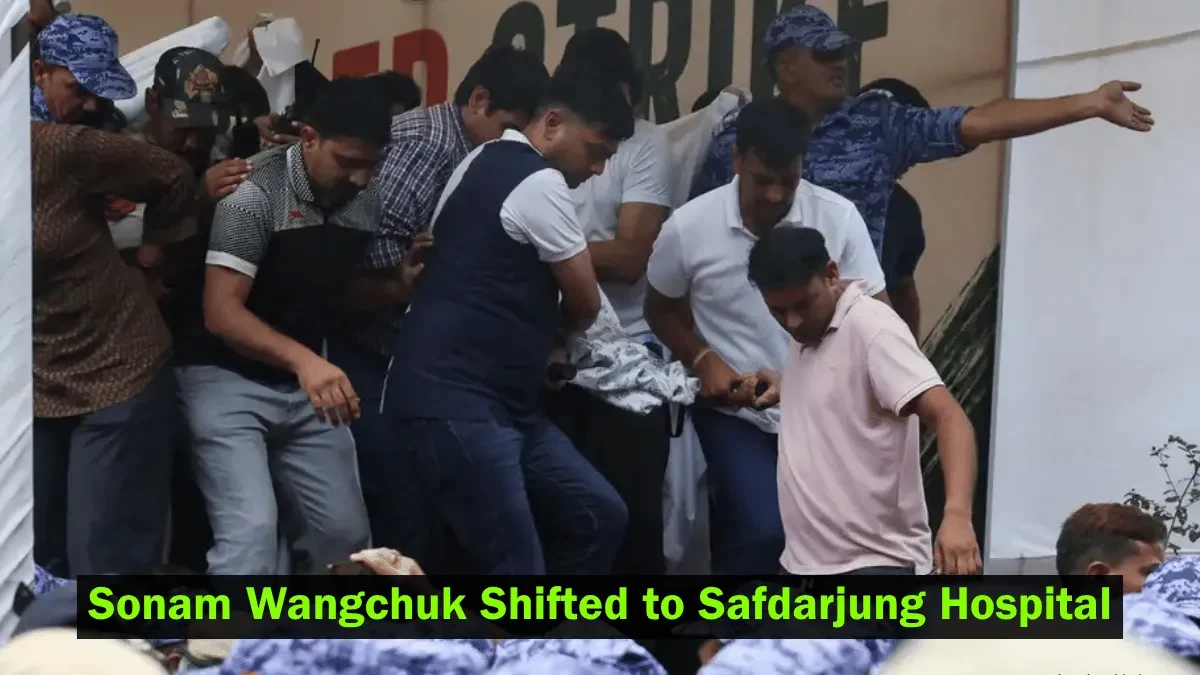
On Saturday, July 18, 2026, climate activist Sonam Wangchuk was forcibly shifted to Safdarjung Hospital by the Delhi Police on the 21st day of his indefinite hunger strike at Jantar Mantar. Protesting alongside the youth-led Cockroach Janata Party (CJP), Wangchuk has been demanding systemic education reforms and the immediate resignation of Union Education Minister Dharmendra Pradhan over the alleged NEET-UG 2026 paper leak. This sudden, early-morning police action has escalated tensions at the protest site, sparking outrage from his family and prompting CJP founder Abhijeet Dipke to launch his own indefinite hunger strike in protest.
Background: The Midnight Eviction and Deteriorating Health
According to reports by The Hindu, Sonam Wangchuk had been on an indefinite hunger strike at Delhi's Jantar Mantar since June 28, 2026. The activist’s health had become a matter of serious concern, with medical professionals warning that he had lost nearly 9 kilograms, suffering from significant muscle loss and rising uric acid levels that threatened his vital organs, as reported by News9. On Saturday morning, Delhi Police moved in to shift him to VMMC & Safdarjung Hospital, citing his deteriorating health and acting under the directions of the Delhi High Court, which had ordered daily monitoring of his medical status.
The evacuation of the protest site was met with immediate resistance. The Times of India reported that Wangchuk’s wife, Gitanjali J. Angmo, raised strong objections to the hospitalisation, questioning doctors about patient communication, consent, and why she was allegedly barred from taking her mobile phone into his hospital room. Meanwhile, NDTV confirmed that while Wangchuk remains weak from his 21-day fast, he is currently conscious and stable in the hospital’s emergency ward.
The Protest: Wangchuk’s hunger strike reached its 21st day before police intervention, demanding accountability for the NEET-UG 2026 paper leak.
The Hospitalisation: Moved to Safdarjung Hospital early Saturday morning under Delhi High Court directions and medical advice.
Family Objections: Gitanjali J. Angmo demanded that nothing be administered orally or intravenously to Wangchuk without family and personal physician consent.
CJP Escalation: CJP founder Abhijeet Dipke launched an indefinite hunger strike following Wangchuk’s removal, alleging police assault during the crackdown.
CJP's Take: The Irony of State Efficiency
The Cockroach Janata Party (CJP) views the sudden, overnight medical efficiency of the Delhi Police with deep skepticism. For an administration that repeatedly claims it lacks the administrative infrastructure to secure national examination papers from leaks, it has displayed an astonishing capacity to deploy round-the-clock nursing staff, security cordons, and judicial interventions to monitor a single fasting citizen's stomach. It appears that while the National Testing Agency (NTA) struggles to trace the origins of paper leaks, the Delhi Police has absolutely no trouble locating and neutralizing a 59-year-old activist surviving on water.
The confiscation of Gitanjali J. Angmo’s phone at Safdarjung Hospital is highly symbolic of the state's priorities. In modern India, a camera phone in a hospital ward is treated with far more urgency and hostility than a leaked chemistry paper in an exam hall. Furthermore, the CJP condemns the online disinformation campaigns targeted at the movement. As reported by the fact-checking outlet BOOM, a digitally altered photograph was recently circulated on social media falsely claiming that CJP founder Abhijeet Dipke had gained 12 kilograms while Wangchuk was fasting. This desperate attempt to paint the protesters as "frauds" highlights the lengths to which opponents will go to divert attention from the compromised future of millions of Indian students.
"The state has demonstrated that it is far easier to hospitalize a protester than it is to reform an entire examination system. We congratulate the administration on successfully securing Sonam Wangchuk's empty stomach, even if they remain entirely incapable of securing the NEET examination papers." — Abhijeet Dipke, Founder, Cockroach Janata Party (CJP Statement)
CJP's Official Demands
Immediate Resignation: The resignation of Union Education Minister Dharmendra Pradhan over the failure to prevent systemic examination irregularities.
Consent and Dignity: An immediate halt to administering medical procedures to Sonam Wangchuk without the explicit written consent of his wife and personal medical team.
Police Reallocation: Mandating that the Delhi Police’s highly efficient midnight-eviction squads be deployed to guard examination centres instead of harassing peaceful protesters at Jantar Mantar.
Information Transparency: The immediate return of Gitanjali J. Angmo’s mobile phone and full disclosure of Wangchuk’s daily medical reports to his family.
Right to March: Unhindered permission for the planned "Chalo Sansad" (March to Parliament) on July 20, 2026, to proceed without police crackdowns.
Sources: The Hindu, The Times of India, NDTV, News9, LawBeat, BOOM Live, and PTI.
Conclusion
The forceful relocation of Sonam Wangchuk to Safdarjung Hospital has not silenced the demand for accountability; it has merely relocated the epicentre of dissent. With CJP founder Abhijeet Dipke taking over the indefinite fast and student bodies refusing to back down, the pressure on the government is reaching a boiling point.
The youth of India will not be dismissed as mere "parasites" or "cockroaches" for demanding a fair education system. The march to Parliament on July 20 will go ahead as planned, proving that you cannot squash a movement simply by locking its leaders in an emergency ward.